
EUDR submission integration
Built for Baldwin Global Consulting's European publishing supply chains.
InvariTech built Baldwin Global Consulting's EUDR submission integration for European publishing supply chains. It validates agreed inputs, prepares Due Diligence Statements, records submission responses, and keeps exceptions visible for review. In 2025, InvariTech recorded a pass on the prescribed acceptance-environment conformance tests against the European Commission's TRACES NT EUDR Information System. This is a self-declared integration test result, not an EU certification or endorsement.
Business Constraints
Legal Exposure
A DDS records the operator's compliance declaration. Incorrect information can create regulatory exposure; a mistake does not automatically trigger a penalty. Data integrity and traceability were core requirements.
Bursty Volume
The design anticipated bursty submission periods. Capacity needs to be tested against the agreed workload rather than inferred from the architecture.
Legacy EU Interface
The EU system relies on SOAP with strict schemas and geo-data formatting. It's not designed for high-volume, ergonomic manual operations.
Solution Overview
In practice, this is EUDR compliance automation backend development: deterministic workflow infrastructure for bursty submission volume, strict regulator interfaces, and defensible evidence trails. For the regulatory requirements behind the submission, see the EUDR due-diligence guide; for the native SOAP interface and response handling, see the EUDR API integration guide.
Structured Validation & API Bridges
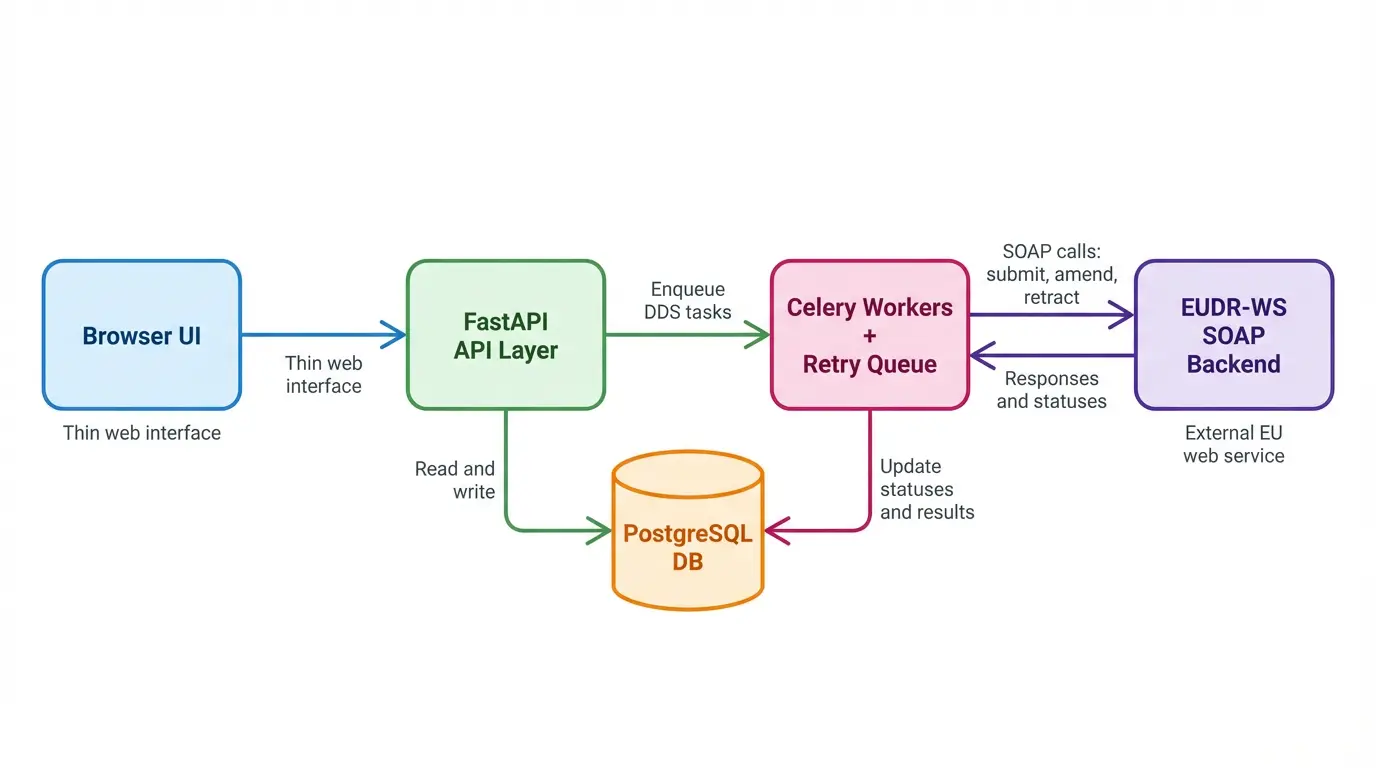
We built a dedicated EUDR backend layer that sits between internal systems and the EU portal. It validates schemas and geo-data deterministically before sending anything to the EU system.
- Structured JSON input from internal tools
- Pre-submission schema + geo-data validation
- JSON-to-SOAP transformation with strict envelopes
Submission Evidence & Operator Dashboard
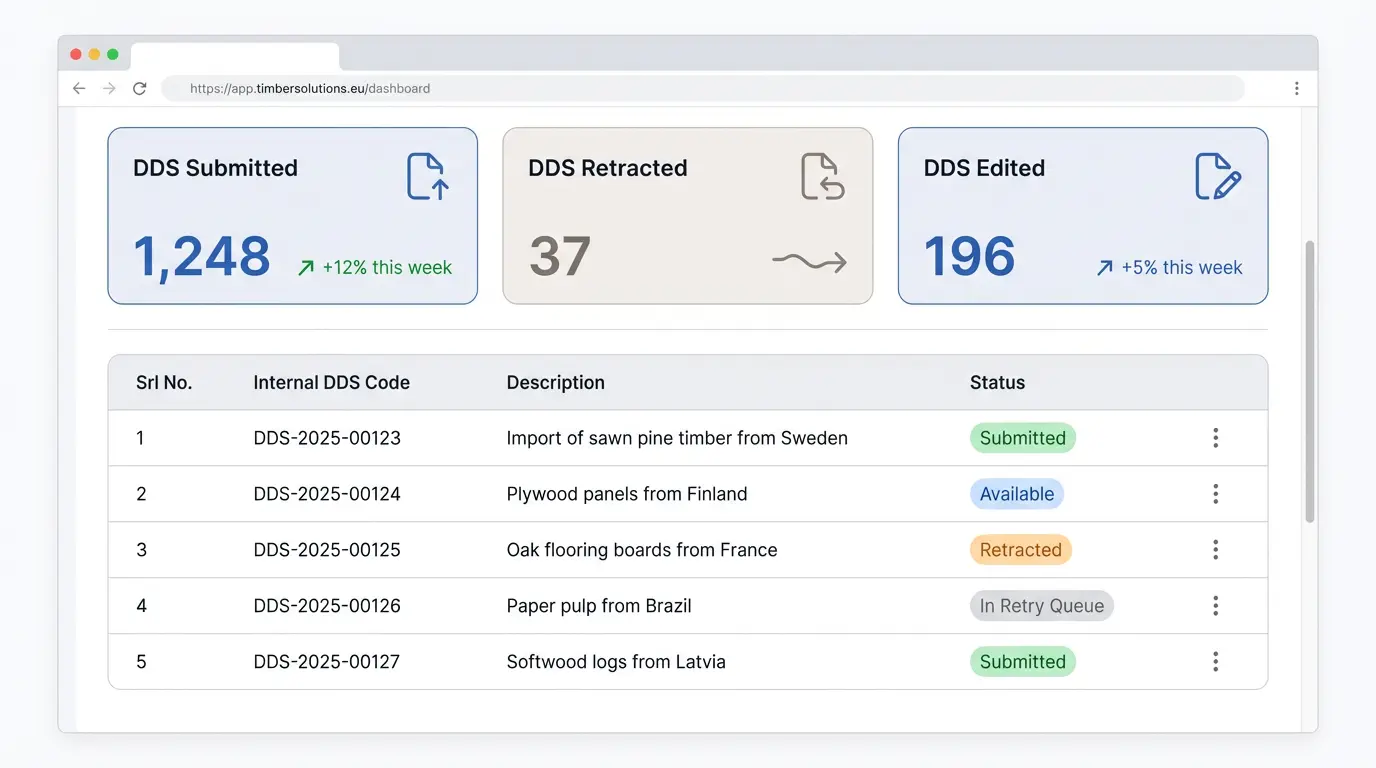
An internal dashboard and submission evidence trail support searching and filtering DDS by status, date and commodity without repeatedly navigating the portal.
Illustrative internal workflow states
These are internal labels, not the Commission’s official status model. Amendments and withdrawals remain subject to the applicable rules and system state.
Retry-Safe Processing
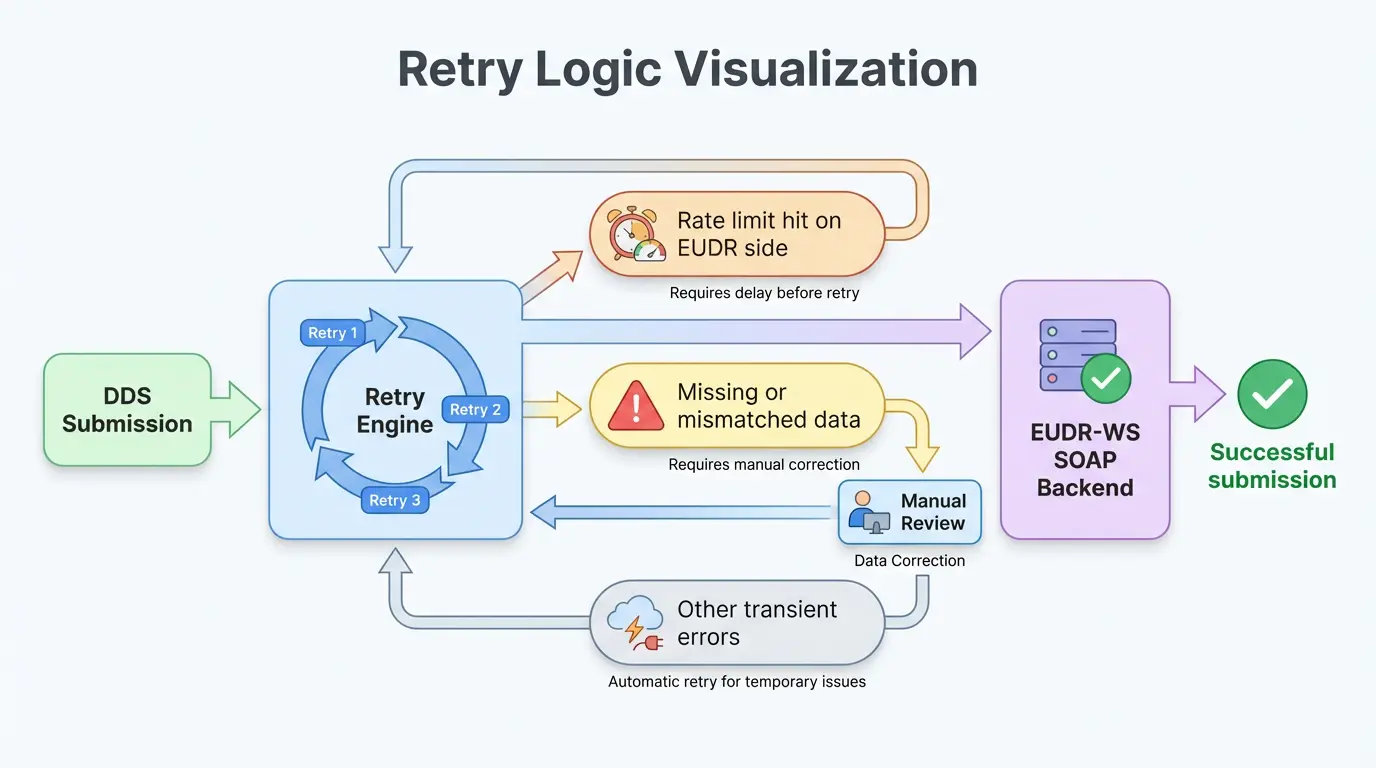
The bridge classifies submission responses and routes them through deterministic handling paths. CF2–CF7 refer to conformance scenarios, not response-code classes.
Retry handling tracks submission state. An uncertain submission outcome must be reconciled before resending; non-transient errors need correction rather than repeated attempts.
Built With
Related reading: deterministic compliance systems and building vs buying custom automation.
The Impact
Throughput must be validated against the agreed workload and current API.
Structured checks before submission.
Submission state and response history.
Traceable state transitions & logs.
Delivery Specs
Core Backend
Hardening & Deploy
Priced Separately
NEED AN EUDR SUBMISSION SYSTEM THAT HOLDS UP?
Bring us your current EUDR submission flow. We will identify the bottlenecks, define the integration boundary, and scope the validation, submission, and evidence infrastructure needed to run it reliably at volume.
See the rest of our implementation work or request an EUDR implementation scope.