
Compliance Workflow Automation: How to Automate Regulated Work Without Losing Control
Filed under
Compliance workflow automation should reduce manual handoffs without giving up control over approvals, submissions, or evidence.
In practice, that means catching invalid data before submission, sending exceptions to someone authorised to resolve them, and keeping a usable record of every material decision. If a system cannot do those three things, it has only made the risky part faster.
This guide explains what to automate, what to keep under human control, where AI helps, and how to design a workflow that produces its own evidence.
What is compliance workflow automation?
Compliance workflow automation is the use of software to coordinate and record a repeatable compliance process from intake through validation, approval, submission, exception handling, and review. It replaces manual handoffs with explicit rules, named owners, controlled state changes, and a durable history of what happened.
The phrase covers several different kinds of work:
- collecting evidence and documents;
- routing approvals and policy attestations;
- monitoring controls or regulatory changes;
- validating data against regulatory rules;
- preparing reports and regulator-facing records;
- submitting data to an external authority;
- tracking acknowledgements, amendments, and exceptions.
Those activities do not carry the same risk. Automating an internal reminder is different from allowing a system to approve a customer, calculate a regulated threshold, or write directly to a regulator's platform. The closer an automated action is to an irreversible decision or external submission, the stronger its controls need to be.
What problem should compliance automation solve?
Start with one workflow, not with a platform or an AI capability.
A good candidate has a clear trigger, repeatable inputs, known validation rules, identifiable exceptions, and a measurable result. It also consumes enough time or creates enough risk to justify changing it.
Examples include:
- checking whether required evidence is present before a filing;
- validating product, entity, or transaction data against known rules;
- routing an exception to the person authorised to resolve it;
- submitting an approved record through an API;
- reconciling an acknowledgement with the original submission;
- assembling the evidence needed for an internal or external review.
Before designing anything, document the current path. What starts the work? Which data is required? Who can approve an exception? Which actions can be reversed? What must be retained? Where does status live today? If the team cannot answer those questions consistently, automation will reproduce the ambiguity at greater speed.
The first objective is therefore not "use AI." It is to make the workflow explicit enough to govern.
Which compliance processes should be automated?
The best candidates are frequent, rules-based, and expensive to perform manually. Human judgment should remain where the facts are ambiguous, the consequence is material, or the decision requires professional accountability.
| Workflow step | Good automation candidate? | Appropriate control |
|---|---|---|
| File intake and format checks | Usually | Reject unsupported or incomplete inputs explicitly |
| Data extraction from documents | Often, with review | Record confidence and send uncertain fields to a person |
| Required-field validation | Yes | Use deterministic rules and version them |
| Threshold calculation | Yes | Test against known examples and retain inputs and outputs |
| Exception resolution | Partly | Route and document; keep the decision with an authorised person |
| Final regulatory judgment | Rarely | Require accountable human review where judgment is involved |
| Regulator-facing submission | Yes, after approval | Control credentials, prevent duplicates, and record responses |
| Status reconciliation | Yes | Match acknowledgements to the originating record |
This is not an argument for keeping humans in every loop. It is an argument for placing them in the loops where judgment, authority, or consequence demands them.
Why deterministic controls matter in regulated workflows
A deterministic rule produces the same result when it receives the same relevant input and rule version. Examples include:
- required field missing: reject the record;
- quantity outside the permitted range: stop and escalate;
- identifier already submitted: block the duplicate;
- temporary connection failure: retry according to a defined policy;
- schema mismatch: preserve the response and send the record to an exception queue.
These rules can be reviewed before deployment, tested with known cases, and traced after execution. That makes them suitable for enforcing boundaries around a regulated workflow.
Deterministic does not mean that every part of the workflow is simple. Rules can depend on jurisdiction, product, role, dates, thresholds, and earlier decisions. The important point is that the result follows from inspectable logic rather than an unrecorded guess.
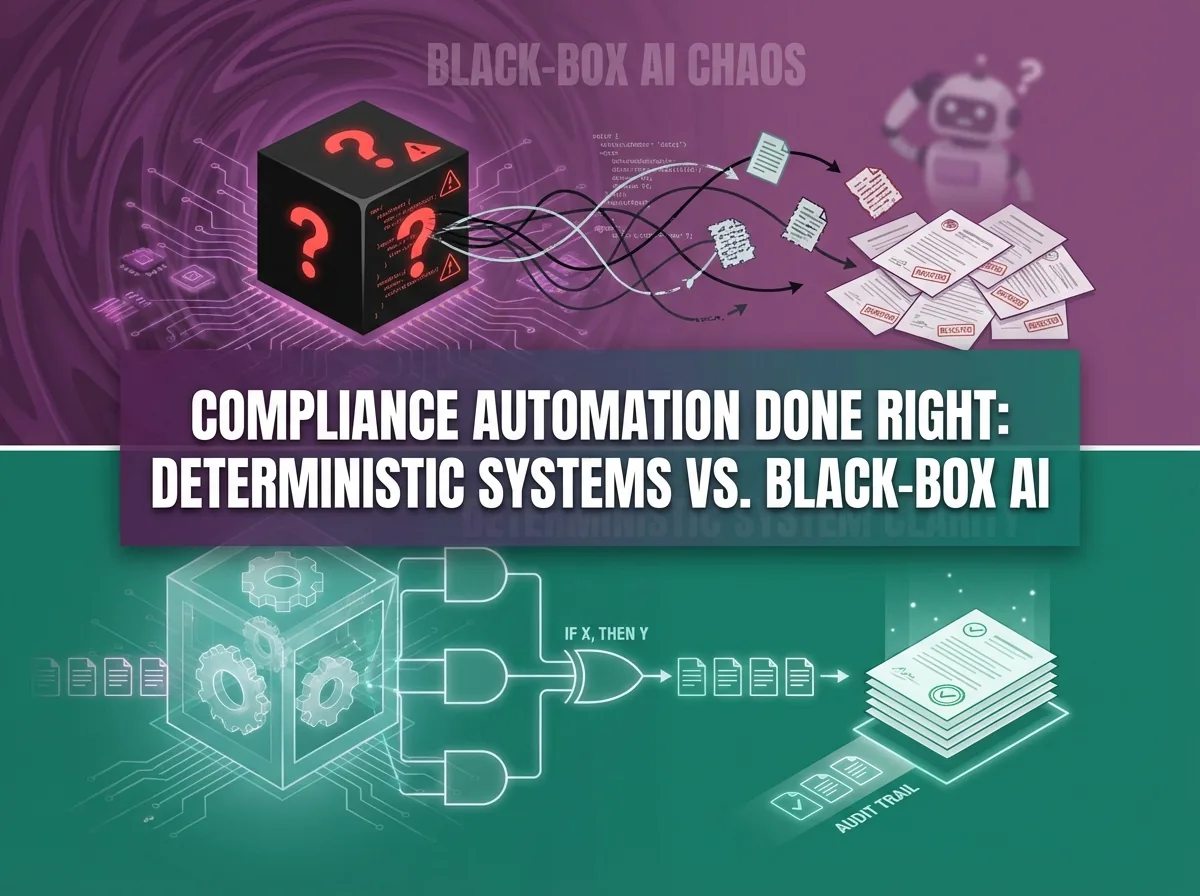
This is what we mean by deterministic compliance: regulatory controls expressed as testable rules, with explicit exceptions and a recorded path from input to outcome.
Where AI belongs in compliance workflow automation
AI is useful where the input is messy and the task tolerates uncertainty. It can extract fields from documents, classify correspondence, compare passages, draft an explanation, or identify records that deserve review.
It is less suitable as the only control for an action that must obey a precise rule. A model may help find a product code in a supplier document. A deterministic check should then confirm that the resulting value is present, structurally valid, and allowed for the workflow before submission.
The risk in AI compliance automation is not that models are useless. It is that black box automation can hide how a consequential result was produced or allow an uncertain output to pass as a verified decision.
| AI assistance | Deterministic control |
|---|---|
| Interprets unstructured material | Enforces a defined rule |
| Returns a result with uncertainty | Returns a reproducible pass, fail, or exception |
| Helps prioritise human attention | Prevents an unauthorised state change |
| Drafts or recommends | Validates, routes, records, or blocks |
| Is monitored for quality and drift | Is tested against versioned requirements |
This separation is consistent with established AI risk guidance. The NIST AI Risk Management Framework calls for documented roles in human-AI configurations (Govern 3.2), documentation of system limits and intended use (Map 2.2), defined human-oversight processes (Map 3.5), and repeatable testing and evaluation (Measure 2.1). NIST describes the framework as voluntary and use-case agnostic, so it is guidance for designing controls rather than a legal requirement.
The EU AI Act provides a narrower legal example. Articles 12 and 14 require automatic event logging and effective human oversight for high-risk AI systems. Those provisions do not apply to every automated compliance workflow. They do show why system classification and context matter: obligations depend on what the system is, how it is used, and the risks it creates.
The practical design rule is straightforward. Let AI propose or extract where ambiguity is unavoidable. Put deterministic checks between probabilistic output and consequential action.
How to build an auditable compliance workflow
An audit trail should be an output of the workflow, not a report reconstructed afterwards. Build it around the questions a reviewer will actually ask.
1. Preserve the original input
Keep the source file, message, API payload, or form submission that started the process. Assign it a stable identifier and record when it arrived. If data is later corrected, preserve both the original and corrected values.
2. Version the applicable rules
A result is only explainable if you know which rules produced it. Store the rule or schema version, its effective date, and the evaluation result. Regulatory logic changes; historical records should remain tied to the requirements used at the time.
3. Record decisions and state transitions
Capture more than the final status. Record validation outcomes, approval or rejection, the responsible actor, timestamps, exception reasons, and every external request and response. A useful history can explain how the record moved from received to validated, approved, submitted, acknowledged, amended, or rejected.
4. Make exceptions explicit
Do not convert an unknown condition into a silent pass. Give exceptions a category, owner, deadline, and resolution. Preserve the evidence considered by the person who resolved them.
5. Separate bad data from system failure
A missing required field should not be retried. A temporary network timeout might be. Classifying failures prevents endless retries, duplicate submissions, and records that appear complete only because an error was swallowed.
6. Reconcile external outcomes
A successful API request does not always mean the business process succeeded. Store the regulator or counterparty response, match it to the originating record, and confirm that the expected state was reached. If acknowledgement is delayed or contradictory, surface that as an exception.
7. Restrict consequential actions
Use role-based access, separate approval from execution where appropriate, protect external credentials, and make high-impact operations idempotent where the interface allows it. A user or retry should not be able to create the same submission twice accidentally.
A worked example: EUDR submission
Consider an operator preparing a Due Diligence Statement under the EU Deforestation Regulation. Supplier files arrive in different formats. Product data, scientific names, quantities, and geolocation information have to be transformed into a regulator-ready record.
A controlled workflow could work as follows:
- AI-assisted extraction reads a supplier document and proposes structured fields, retaining the source and confidence information.
- Deterministic validation checks required fields, identifiers, coordinate structure, allowed values, and file limits.
- Records that fail a rule enter an exception queue with the failed rule, source value, and named owner.
- An authorised person reviews any ambiguous or corrected information and records the reason for the decision.
- The approved payload is submitted through the Commission interface with controlled credentials.
- The request, response, reference number, and verification number are stored against the original record.
- Later amendments, withdrawals, grouping, or rejection update the lifecycle without deleting the earlier history.
The correction window makes these controls operationally important. Article 5 of Commission Implementing Regulation (EU) 2024/3084, as amended by Implementing Regulation (EU) 2026/1565, generally allows a submitted statement to be amended or withdrawn within 72 hours after its reference number is made available, subject to conditions that can close the window earlier. Finding an error during a monthly review may therefore be too late.
The deterministic check is not attempting to replace the operator's due diligence judgment. It is preventing a known structural or data error from reaching a consequential action unnoticed.
This control pattern is implemented in the EUDR Compliance Bridge architecture, where validation, submission state, and returned identifiers remain tied to the original case.
Common compliance automation failure modes
Automating an undefined process
If two experienced team members handle the same case differently, the workflow needs clarification before implementation. Software cannot resolve an ownership or policy gap by itself.
Treating an AI answer as a control
A plausible answer is not the same as a verified condition. If a requirement can be expressed as a rule, enforce it as a rule after extraction or classification.
Logging too little
A timestamp and final status do not explain a decision. Retain the input, rule version, evaluation, actor, exception, and external response needed to reconstruct it.
Logging everything without structure
Raw application logs are not automatically an audit trail. Evidence needs stable record identifiers, meaningful event types, access controls, retention rules, and a way to retrieve the history of one case.
Retrying every failure
Retries help with transient infrastructure faults. They do not fix invalid data, expired credentials, changed schemas, or rejected decisions. An uncontrolled retry can also create duplicates.
Removing the human but keeping the ambiguity
Some exceptions require legal, compliance, or operational judgment. The workflow should route those cases with context and record the decision, not force them through an artificial yes-or-no rule.
How to plan a compliance automation project
Use a narrow first implementation that proves control as well as efficiency.
- Choose one workflow. Select a recurring process with measurable effort, delay, rework, or exposure.
- Map the current state. Document triggers, inputs, rules, owners, systems, exceptions, outputs, and retention needs.
- Classify every decision. Mark it as deterministic, judgment-based, or suitable for AI assistance with review.
- Define the evidence model. Decide what must be recorded to explain each material outcome.
- Design failure behaviour. Specify which failures stop, retry, escalate, or require manual recovery.
- Test known and adverse cases. Include missing data, conflicting evidence, duplicates, timeouts, schema changes, and unauthorised actions.
- Measure the result. Compare cycle time, exception rate, correction time, manual touches, and unresolved records with the baseline.
The first release should make one important workflow more observable and controllable. Expanding a weak design only makes its weaknesses harder to find.
When should you build rather than buy?
Off-the-shelf software is usually the better choice when the workflow is common, integrations are standard, and the organisation can adopt the product's process without losing an important control.
Custom compliance workflow automation becomes more reasonable when the process contains organisation-specific regulatory logic, connects several internal and external systems, operates at volumes where small errors compound, or requires an evidence model that a generic platform cannot represent.
The decision is not simply software licence versus development cost. Include implementation, process adaptation, integration, exception handling, ongoing rule changes, and the cost of being unable to explain or correct an outcome.
For a fuller decision framework, read Building vs. Buying: When Custom Automation Makes Sense.
Questions teams ask about compliance workflow automation
Can AI automate regulatory compliance?
AI can assist with document extraction, classification, comparison, drafting, and anomaly detection. It should not be treated as the sole control for a precise regulatory rule or consequential external action. Use deterministic validation and proportionate human oversight between AI output and decisions or submissions that require consistency and accountability.
How do you maintain an audit trail in an automated compliance workflow?
Generate evidence as the workflow runs. Preserve original and corrected inputs, applicable rule versions, validation results, approvals, human interventions, state transitions, exceptions, and external responses under a stable record identifier. Test whether a reviewer can reconstruct one outcome without relying on inboxes or staff memory.
What is the difference between compliance automation and RegOps?
Compliance automation is a capability. RegOps is the operating model around it: how teams structure intake, encode rules, manage exceptions, control submissions, maintain evidence, and change the system as requirements evolve. In EUDR, a TRACES NT API integration is one technical implementation of that model.
The standard is controlled execution
Good regulatory compliance automation does more than remove manual steps. It makes each material action easier to validate, trace, interrupt, and explain.
The core pattern is simple: use AI where interpretation helps, deterministic rules where a boundary must hold, and accountable people where judgment remains. Record the path while the work happens.
If you are deciding whether one of your workflows needs this level of infrastructure, map it with the engineering team. Start with the inputs, rules, exceptions, external actions, and evidence required to explain one real case from beginning to end.
Want us to map one live finance or compliance workflow?
Bring one finance or compliance workflow. We will map the current process, find where controls are missing, and recommend the smallest useful build scope.