
What Is RegOps? A Practical Guide to Regulatory Operations
Filed under
What is RegOps?
RegOps, short for regulatory operations, is the operating model that turns regulatory obligations into repeatable day-to-day work. It defines how data is collected, checked, approved, submitted, corrected, and retained as evidence.
The name is used in three related ways:
| Context | What RegOps usually means |
|---|---|
| Banking | Infrastructure for exchanging regulatory data between regulated firms and regulators |
| Life sciences | Teams and systems that manage submissions, publishing, information, and submission records |
| Software development | Regulatory DevOps, where compliance work is built into the development lifecycle |
These uses come from different industries, but they address the same operational gap: turning regulatory requirements into controlled, repeatable work with evidence attached. TOPRA, the professional body for regulatory affairs, describes regulatory operations in life sciences as specialising in systems, processes, data, and regulatory submissions.
A 2021 paper in the ISI World Statistics Congress proceedings describes a RegOps model for exchanging regulatory data. Its authors represented the Croatian National Bank, Oesterreichische Nationalbank, and the vendor BearingPoint RegTech. A later study of RegOps in regulated software development found that industry commonly uses the term for Regulatory DevOps.
In this article, RegOps means the broader operating model behind regulatory work. It covers the people, procedures, data, systems, and controls needed to move from an obligation to a completed submission or report, with usable evidence of what happened. Software can support that model, but buying software does not create it.
What problem does RegOps solve?
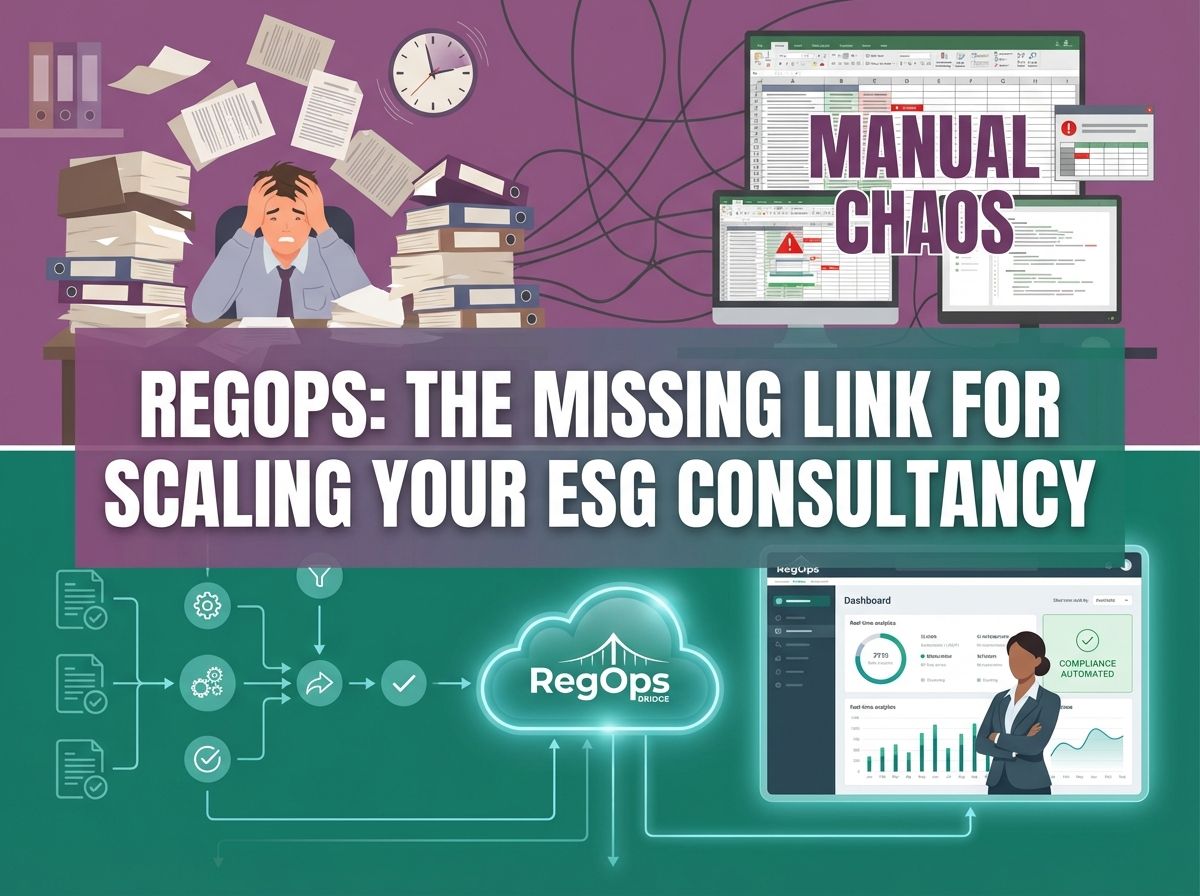
Regulatory work often starts with a manageable process. A client or colleague sends a spreadsheet. An analyst checks it, asks for missing information, copies the final values into a portal, and saves a screenshot as proof.
That process may work for ten submissions. At one hundred, familiar problems appear:
- nobody can see which version is final
- the same data is checked more than once
- missing information is found close to the deadline
- submission status lives in inboxes or personal trackers
- senior staff spend time chasing records instead of resolving exceptions
- evidence has to be reconstructed after the work is complete
These are not simply software problems. They are signs that the operation depends on individual memory and coordination. RegOps replaces that dependency with an explicit process: one source of status, defined checks, named approval points, and evidence captured as the work happens.
What does a RegOps process include?
A working RegOps process answers six questions:
- Intake: What information is required, in what format, and from whom?
- Validation: Which errors can be detected before a person reviews the case?
- Ownership: Who resolves an exception, and who can approve the result?
- Transformation: How does approved source data become the format required by the regulator?
- Submission: Who or what sends the record, and how is the response captured?
- Evidence: Can the organisation show what was submitted, which checks ran, who approved it, and what changed later?
This is the work that sits between a regulation and a successful filing. A policy may state the obligation, while a portal accepts the final record. RegOps governs everything required to move reliably from one to the other.
| Part of the operation | What RegOps must establish |
|---|---|
| Systems | Where work is performed and which systems exchange data |
| Processes | The sequence of checks, approvals, submissions, and corrections |
| Data | Required inputs, accepted formats, ownership, and version control |
| Submissions and reporting | How approved data reaches the regulator and how responses return |
| Decisions | Who can resolve exceptions, approve a result, or accept risk |
| Evidence | What is retained to show what happened, when, and under whose authority |
RegOps is not the same as RegTech
| RegTech | RegOps |
|---|---|
| Technology used for regulatory compliance | The operating model for regulatory work |
| A product or technical capability | People, process, data, controls, and supporting systems |
| Helps perform a task | Defines how the task is owned, checked, approved, evidenced, and corrected |
A team can buy a RegTech product and still rely on email for approvals, spreadsheets for corrections, and screenshots for evidence. It has acquired a tool without fixing the operating model. The reverse is also possible: a team can improve ownership, validation, and record-keeping before introducing new software.
// NOTEPoor process does not disappear when it is automated. It becomes harder to see and faster to repeat.
A concrete example: EUDR submissions
The EU Deforestation Regulation requires upstream operators to submit due diligence statements, with a simplified declaration regime for qualifying micro or small primary operators. Downstream operators and traders do not submit their own DDS for that downstream transaction. Producing a statement can involve supplier data, product classifications, quantities, geolocation data, due diligence results, internal approval, submission, and the return of a reference number.
Without a defined operation, staff may collect those elements in separate files, correct them shortly before submission, and manually copy values into the system. The filing can succeed while leaving the organisation unable to answer basic questions later: Which source file supplied this coordinate? Who approved the change? Was the customs record updated with the final reference number?
A RegOps process gives each statement a controlled path. Required fields are checked at intake. Invalid records are stopped before submission. Exceptions go to the right owner. Approval is recorded. The submission response is attached to the same case. Customs and internal systems receive the accepted reference rather than an earlier draft value.
The regulation has not changed. The organisation has changed how it carries the obligation.
The EUDR due diligence process is one concrete example of this operating model, from source evidence and risk assessment through DDS submission and record retention.
What should remain under human control?
RegOps does not mean automating every decision. Rules-based checks are well suited to required fields, permitted formats, reconciliations, duplicate detection, deadlines, and routing. People should retain control where a decision depends on incomplete evidence, interpretation, risk acceptance, or formal accountability.
AI can help classify documents, extract candidate values, or summarise a case. Its output should be treated according to the consequence of an error. A suggested commodity code can be reviewed. An uncertain value should not pass silently into a regulator-facing submission.
// NOTEThe control boundary: automate stable, testable steps; route uncertain cases to an authorised person; record both the automated result and the human decision.
That boundary between AI assistance, deterministic rules, and accountable review is central to compliance workflow automation.
When does an organisation need RegOps?
You probably do not need a RegOps programme for a new obligation with a handful of cases. First learn the work. The need becomes clearer when the same operational failures recur.
Look for these signs:
- submission or reporting cycles repeat
- volumes are increasing
- deadlines regularly create overtime or last-minute escalation
- the same information is copied between several systems
- key steps depend on one experienced person
- reviewers spend time finding evidence rather than assessing it
- corrections are common but their causes are not measured
- management cannot see current status without asking the delivery team
One signal may justify a process fix. Several together usually mean the work needs a designed operating model.
How should you start?
Start with one recurring regulatory workflow, not an organisation-wide transformation.
Follow a real case from first request to final evidence. Record every handoff, system, spreadsheet, approval, correction, and wait. Then measure four things: volume, processing time, exception rate, and rework. This will show whether the main constraint is missing data, unclear ownership, manual entry, review capacity, or system integration.
Fix the process in that order. Define the required inputs and owner for each exception before automating the movement of data. Otherwise, the system will deliver incomplete work to the wrong person more efficiently.
Where software is justified, connect it to a specific control or bottleneck. A validation rule should prevent a known error. An integration should remove a known rekeying step. A dashboard should answer a decision-maker's actual status question.
For EUDR, this operating model becomes a SOAP-based TRACES NT API integration with controlled validation, reconciliation, and exception handling. Regulatory operations automation can support the same pattern across other recurring obligations.
What is the outcome of RegOps?
A good RegOps model does not make regulation disappear. It makes the work easier to run and easier to inspect.
Teams know what is waiting, what failed, who owns the next action, and which version was submitted. Experts spend more time on exceptions and judgment. Managers can see capacity and recurring failure points. Auditors can follow the record without asking the team to rebuild it from email and screenshots.
The practical test: if regulatory volume rises, can the organisation handle it without losing control of the data, the decision, or the evidence?
Want us to map one live finance or compliance workflow?
Bring one finance or compliance workflow. We will map the current process, find where controls are missing, and recommend the smallest useful build scope.