
When Does a Compliance Consultancy Need an Automation Audit?
Filed under
Are Your Experts Doing Work a System Could Handle?
If your senior consultants spend more time moving client data between spreadsheets, inboxes, shared drives, and portals than applying their expertise, the problem may not be headcount. Your workflow may have outgrown manual delivery.
An automation audit helps answer a practical question: which parts of the delivery process are repeatable enough to systemize, and which still require professional judgment?
The audit starts with the work as it happens today. It maps intake, validation, handoffs, approvals, submissions, corrections, and evidence retention. It does not assume that buying software or adding staff is the answer.
The goal is to find the delivery bottleneck before it becomes an expensive one.
What Should an Automation Audit Measure?
Start with four measures across a representative set of client engagements:
- hours spent on repeatable workflow steps
- rework frequency and the reasons for it
- filing or delivery cycle duration
- exception rate and the time needed to resolve exceptions
These measures distinguish a capacity problem from a process problem. If the same data is entered several times, the same checks are repeated, or the same handoff regularly creates rework, the workflow is a candidate for automation. If the work is genuinely case-specific, the right answer may be better guidance or staffing instead.
Our view: the best consultants should not spend their week proving that a spreadsheet, portal, and inbox agree with each other. That work should be systemized. Their time should go into judgment, client advice, exception handling, and risk interpretation.
For a compliance consultancy in any market, this is the point where growth starts to feel heavier instead of more profitable.
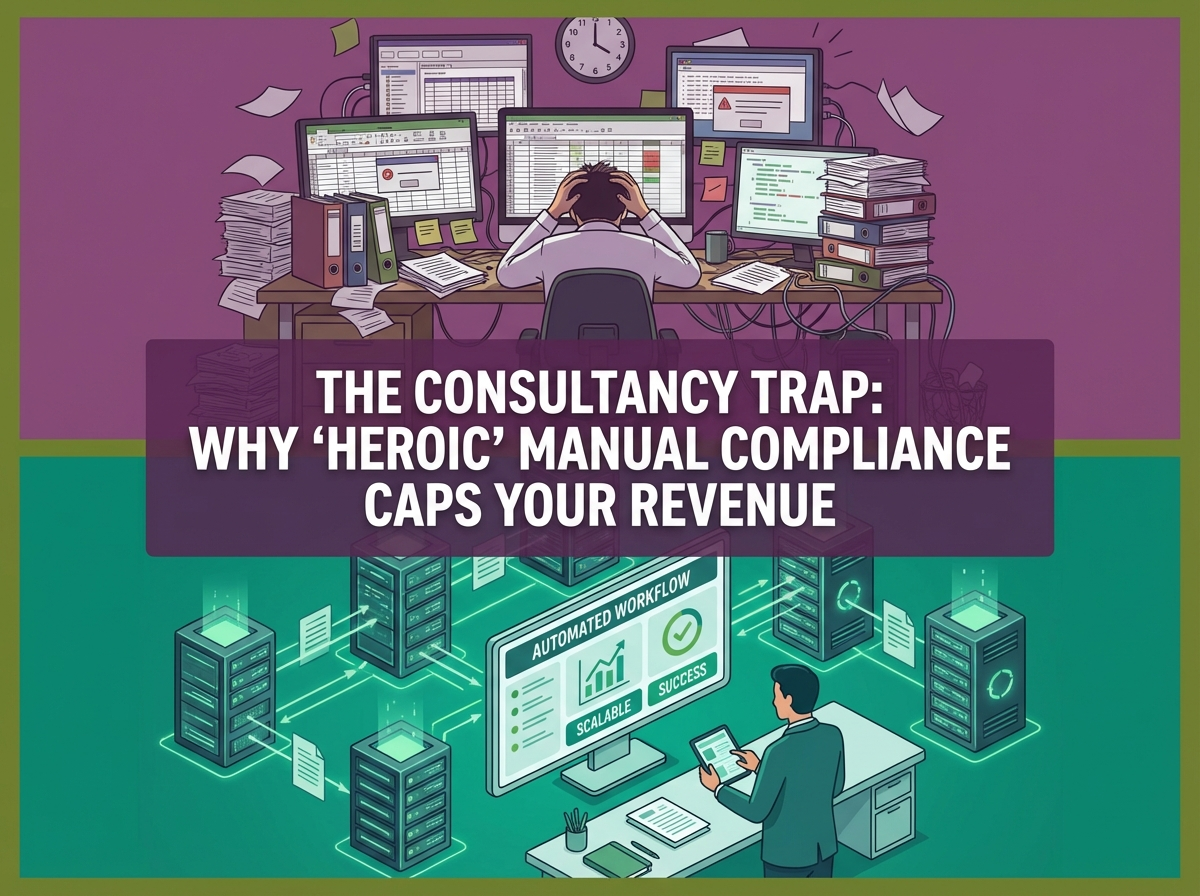
The Quiet Cost of "Heroic" Compliance Work
Some compliance firms take weeks to file what should take days. They request documents in fragments. They go back and forth unnecessarily. Complexity quietly increases.
Sometimes that complexity is accidental. Sometimes it is how lock-in happens. Either way, it costs you.
Heroics erode:
- margin: senior experts spend time moving data instead of interpreting it
- trust: a missed deadline or mis-filed submission damages credibility fast
- transparency: manual systems make it hard to prove what was done and why
- growth capacity: you hesitate to take on larger mandates because you know the internal system cannot absorb them
Internal processes can become a growth constraint. Each larger mandate adds more records, evidence, deadlines, and handoffs for the same team to hold together.
The sales pipeline may be doing its job. The delivery system is where the strain shows up. Without restructuring, small inefficiencies collect over time and turn growth into operational risk.
The Self-Deception Layer
A familiar response is: "We'll systemize later."
Closely followed by: "We can always add more personnel." Hiring rarely fixes the bottleneck. Why Consultancies Get Stuck explains why. The same trap hits earlier for smaller teams: why small businesses reach the automation breaking point maps exactly where the pressure concentrates.
And sometimes: "We already have a system," which means copying data into Excel sheets with slightly better formatting.
Hiring is linear scaling. Linear scaling caps margin.
At some point, adding headcount increases coordination complexity faster than it increases output. You start managing people instead of improving throughput.
If the firm depends on a few senior people to carry every exception, the business is already slower than it looks on paper.
What Does the Audit Tell You?
Larger contracts feel risky. Volume increases create anxiety. Recurring work feels like recurring chaos.
That is not a sales issue. It is an operating model issue.
The output should be a clear separation between work that can run through controlled workflow logic and work that needs a consultant.
The question is not whether automation is fashionable. It is whether the same process can be delivered repeatedly, with the same controls and usable evidence, without consuming more expert time each time volume increases.
When Automation Is Not the Answer
Automation is premature when the client base is still small and manageable, the founding team can directly oversee every case, each engagement is truly bespoke with no repeatable pattern, or there is no stable manual process yet.
If every case is unique and requires independent legal interpretation, forcing automation is artificial.
Infrastructure should follow repeatability, not precede it.
That is the line. Automate the repeatable parts. Keep humans on judgment and escalation.
When You Have Crossed the Line
You likely need RegOps infrastructure when:
- filing cycles feel like recurring fire drills
- larger mandates create operational fear
- senior staff spend meaningful hours on data movement
- you cannot clearly map lifecycle state for every filing
- a key employee leaving would destabilize deadlines
At that stage, hiring more analysts increases complexity without increasing resilience.
The problem is not talent. It is system design.
The real signal is when senior people spend their week moving data instead of applying judgment.
What Replaces Heroics
You replace memory with structure.
You replace inboxes with intake logic.
You replace spreadsheet status columns with explicit lifecycle state.
You make audit logging default.
You shift humans toward exception handling and advisory work.
This is RegOps: operational infrastructure that supports revenue expansion without increasing fragility.
In practice, the delivery system handles two jobs: repeatable workflow logic such as intake, routing, status transitions, and scheduled work; and the integrations that connect those steps to approval workflows and submission targets. Both can sit over your existing systems without displacing them. The workflow automation work we deliver shows what that looks like in practice.
A Concrete Example: EUDR
Regulatory submission pipelines make the problem obvious: manual EUDR compliance fails at scale when volume turns every correction into a coordination task. The EUDR Compliance Bridge case study shows the infrastructure pattern used to control that work.
Valuation and Risk
Growing without strong internal systems is risky. Manual heroics affect trust when something is mis-filed, transparency when a deadline is missed, and liability when a submission is incorrect.
Enterprise buyers and investors look for delivery resilience. If your operating model depends on individual memory rather than explicit systems, that risk is visible during due diligence.
It may not show up in your monthly P&L. It shows up in valuation confidence.
This is especially true once delivery becomes a core part of the product, not just a service add-on.
Strategic Trade-off
The decision is whether to scale headcount or scale throughput.
Headcount growth increases cost linearly. Throughput growth requires infrastructure.
If you cannot confidently double volume without doubling stress, your workflow is the constraint.
Run an Automation Audit Before You Hire
Before hiring again, run an automation audit. Quantify hours spent on repeatable workflow steps, rework frequency, filing cycle duration, and exception rate. Those four measures show whether the constraint is capacity, process design, or judgment.
If that mapping is difficult, treat that as a diagnostic signal.
Map the workflow that creates the most repeated rework and quantify the time it consumes. If the same steps recur across clients, that is the point to consider infrastructure rather than another hire.
This approach does not replace consultants. It protects growth capacity by reducing workflow fragility.
Want us to map one live finance or compliance workflow?
Bring one finance or compliance workflow. We will map the current process, find where controls are missing, and recommend the smallest useful build scope.