
EUDR TRACES NT API Integration: SOAP, DDS Submission, and Error Handling
Filed under
What is the EUDR TRACES NT API?
The EUDR TRACES NT API is the European Commission's machine-to-machine interface for managing Due Diligence Statements and Simplified Declarations in bulk. It connects an operator's system to the EUDR Information System without requiring staff to enter every statement through the web interface.
The Commission's Information System guidance links to the API documentation and advises users to check it regularly because specifications are revised. The interface uses SOAP web services, WSDL and XSD definitions, and WS-Security. It is not a public JSON REST endpoint.
That distinction matters. A vendor may offer a REST wrapper around its own platform, but the underlying EU interface still has its own authentication, schemas, conformance tests, responses, and lifecycle rules.
Account setup remains a separate concern: production and acceptance require their own TRACES NT registration. This article covers the integration itself.
What must the integration control?
An API connection is only the submission edge. A reliable EUDR integration must also control the data required for an EUDR due diligence statement before submission and the record after the Commission responds.
It needs to:
- accept data from defined source systems
- validate required fields and permitted formats
- transform approved data into the Commission schema
- authenticate without exposing the application key
- submit and retrieve reference numbers
- classify errors without retrying invalid data indefinitely
- preserve every request, response, correction, and approval
- send the accepted reference number to the downstream customs process where required
The integration may sit between an ERP, supplier-data store, internal approval workflow, and TRACES NT. Its job is to make those handoffs explicit and recoverable.
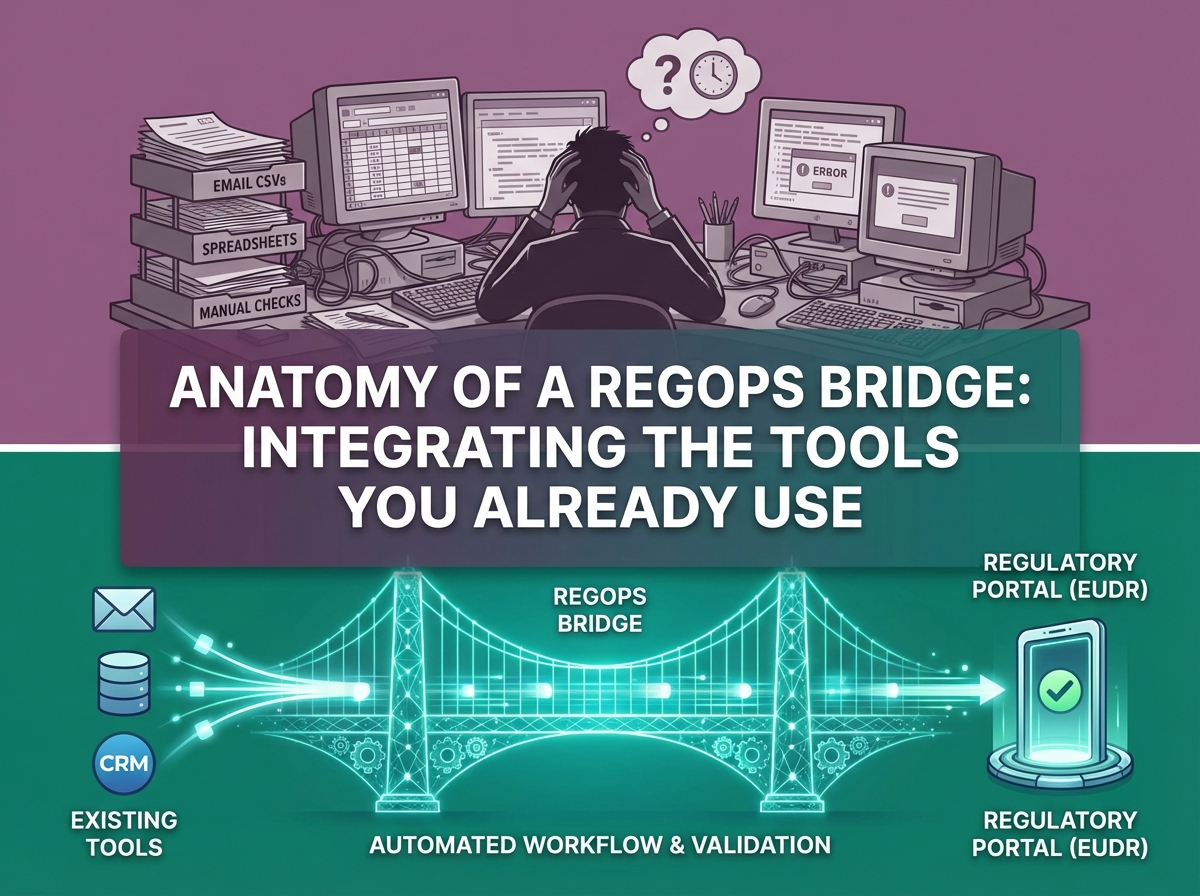
The three integration boundaries
The pipeline connects three surfaces:
- Client surface: email attachments, CSV files, ERP exports, spreadsheets
- Operational surface: CRM, shared folders, ticketing, internal dashboards
- Regulatory surface: the EUDR Information System, SOAP services, schema-bound requests, and returned identifiers
The integration does not need to replace these tools. It needs a controlled communication model between them.
Why SOAP and WS-Security change the build
The Commission's operator API specification requires SOAP web-service calls and supplies WSDL and XSD files for the services. Authentication uses an EU Login username and a separate Authentication Key generated in the Information System. The WS-Security policy uses username-with-digest-password credentials over HTTPS and includes non-replay controls.
Treat the Authentication Key as a production credential. Keep it outside workflow definitions and logs, restrict access, and rotate it through a controlled process. A successful HTTPS connection does not prove that the SOAP message, security header, or DDS payload is valid.
Check the API version before generating a client. The Commission's V2-to-V3 migration guide combines submission and retrieval in one DDS service. In V3, withdrawal uses withdrawDds rather than retractDds, and reference retrieval uses getDds rather than getDdsInfo. Confirm which version your target environment supports; older examples are not interchangeable with the V3 contract.
The practical result is a layered failure surface:
- transport and availability failures
- authentication or WS-Security failures
- malformed SOAP envelopes
- XSD validation failures
- valid messages containing unacceptable business data
- lifecycle failures, such as attempting an amendment after it is no longer permitted
Do not collapse these into one generic "API failed" state. Each requires a different operational response.
How do you integrate TRACES for multiple operators?
A service provider needs to answer two questions for every request: which account is making the call, and which operator's record is it handling? Keep those answers separate from the moment a client is onboarded. A successful connection is not enough if the response ends up in another client's case.
The Commission's V3 multi-operator specification describes a BodyIdentity SOAP header containing an OperatorAccessIdentifier. It selects the operator context when an API user is linked to multiple operators; omitting it in that scenario causes rejection. This is different from WebServiceClientId, which identifies the web-service client, and the EU Login username and Authentication Key used for authentication.
Check the environment before building around this feature. The published V3 reference still warns that its endpoints are not yet accessible and contracts may change. The access guide also retains a single-operator restriction elsewhere on the same page. Confirm the supported account setup and service version with EUDR technical support, then test them in acceptance. Published XML is not evidence that your production account can use it.
For representative submissions, there is another distinction: the V3 DDS payload requires representedOperator when operatorRole is REPRESENTATIVE_OPERATOR. That field identifies the client represented in the statement. BodyIdentity selects the operator context for the API request; it does not replace the represented-client fields. Configure and test both mappings for the supported account arrangement, rather than assuming the same identifier belongs in both places.
Keep the client identity attached to the job
For a multi-client integration, we recommend these controls:
| Control | What it prevents |
|---|---|
| Bind the client, legal entity, operator identifier, environment and credential reference when the job is created | A worker picking up whichever client was selected most recently |
| Check the client's approval and applicable authority before submission | Treating technical access as permission to file |
| Store returned identifiers and attempts under the same client and job | A valid response being assigned to the wrong client |
| Reconcile an uncertain result using the original operator context | Retrying a timed-out request under another operator |
| Keep keys in a restricted secret store; log credential references, never keys | Exposing credentials through shared logs or support exports |
| Test two fictional operators, including deliberately mismatched jobs | Cross-client defects hidden by a single-operator test |
These are our engineering recommendations, not a claim that the Commission prescribes this internal design. The header selects a technical context; the authority to submit for a client must be established separately. Record that authority and the responsible approver during client onboarding, rather than asking a background worker to infer them from an identifier.
Route DDS and simplified declarations separately
The V3 documentation defines separate services:
- DDS:
EUDRDueDiligenceStatementServiceV3 - Simplified declarations:
EUDRSimplifiedDeclarationServiceV3
Resolve the client's applicable filing obligation before choosing the service. Do not turn a DDS into an SD merely because the payload is smaller or the client is described as a small business.
Keep the statement type beside the client identity throughout validation, submission and retrieval. For example, a DDS reconciliation job should not reuse another client's SD service settings just because both operations run through the same queue.
For EUDR delivery across several client operators, these boundaries belong in the implementation scope alongside the SOAP connection. Agree who owns client setup, approvals and unresolved submissions before automating the first filing.
How DDS submission actually completes
Submission and acceptance are not one event. In the Commission's published conformance material, the submission call returns an HTTP success code and a generated UUID. That UUID identifies the statement in later web-service calls. Retrieving the DDS reference number is tested separately.
A production workflow therefore needs at least these local states:
| Local state | Meaning | Next action |
|---|---|---|
| Draft | Source data is incomplete or still under review | Complete and approve the record |
| Ready | Local validation and approval have passed | Build the SOAP request |
| Submitting | A request has been sent but the outcome is not yet reconciled | Preserve the request and await or retrieve the result |
| UUID received | TRACES accepted the submission call and returned its identifier | Retrieve the DDS information and reference number |
| Reference received | The reference and verification numbers are stored locally | Release them to authorised downstream processes |
| Rejected locally | The record failed an internal rule | Correct the source data before sending |
| Rejected remotely | TRACES returned a structural or business error | Classify, correct, and resubmit only when appropriate |
| Amendment pending | An approved correction is being prepared | Recheck legal eligibility immediately before sending |
| Closed | No further automated action is permitted or required | Retain the record and evidence |
These are recommended internal states, not status names prescribed by the Commission. Keep the EU response alongside the local classification so a reviewer can distinguish what TRACES reported from what your system decided to do next.
When is a retry safe?
Error handling was one of the earlier conformance tests. Regardless of the current access process, your integration needs an explicit retry policy for each failure class; the historical test list is not that policy.
Retry only when repeating the operation cannot conceal a data problem or create an unresolved duplicate. A connection timeout or temporary service failure may be transient. An XSD validation error, rejected field value, expired amendment window, or invalid credential will not become valid because the same request is sent again.
The difficult case is an ambiguous timeout after submission. The request may have reached TRACES even though your application did not receive the response. Do not assume failure and immediately create another statement. Keep the exact outbound request and internal reference, then reconcile using the API's retrieval operation before deciding whether a new submission is necessary.
The API material describes identifiers and retrieval operations, but it does not promise a general idempotency key for submission. Any deduplication rule in your application is therefore an internal control and should be labelled as such.
| Failure class | Default handling |
|---|---|
| Local or XSD validation failure | Stop; correct the record |
| Authentication or WS-Security failure | Stop; fix credentials, clock, or security construction |
| Explicit business rejection | Stop; route to the responsible owner |
| Confirmed temporary availability failure | Retry with bounded backoff |
| Timeout with unknown submission outcome | Reconcile first; do not blindly resubmit |
| Amendment no longer permitted | Stop automation and route for legal or competent-authority handling |
Test the integration before production
The Commission's V3 access guide recommends setting up credentials and testing the integration in acceptance before repeating the setup for production. Earlier API documentation specified conformance tests, but the V3 access guide does not restate the CF1–CF7 approval process. This omission does not establish that the requirement was abolished. Confirm any applicable conformance requirements with EUDR technical support before going live.
For your own integration testing, we recommend checking these seven capabilities against the API version you use:
- establish an authenticated connection;
- submit a valid DDS;
- retrieve its information and reference number;
- handle invalid submissions and returned errors;
- amend a DDS while amendment remains permitted;
- withdraw a DDS while withdrawal remains permitted;
- retrieve an upstream DDS using the supported identifiers and access permissions.
This is our recommended checklist, not a claim about the current Commission approval scheme. The May 2024 notice relaying Commission instructions described the first four tests as mandatory and the three additional capabilities as optional. A historical CF1–CF7 result does not establish compatibility with a revised API. Include additional tests for any newer features your integration uses.
Acceptance and production require separate registration. A successful acceptance test does not create production access, and acceptance submissions have no legal value. Keep environment credentials, endpoints, data, and monitoring separate so a test request cannot be mistaken for a filing.
The Commission explicitly tells API developers to monitor its documentation folder for revisions. Generate clients and validation code from the version of the WSDL and XSD approved for your connection, and treat a specification change as a controlled release rather than silently replacing schemas in production.
Amendments are lifecycle operations, not ordinary retries
Article 5(1) of Commission Implementing Regulation (EU) 2024/3084 generally enables amendment or withdrawal within 72 hours after the reference number becomes available. The window can close sooner when the product has already been placed on the market or exported, the reference has been provided to customs, or the user has been notified of a check.
Implementing Regulation (EU) 2026/1565 prevents amendment or withdrawal once the same user has referenced the DDS in a grouped DDS under Article 8a. Article 5(4) allows a competent authority to grant an extension of no more than eight calendar days after the normal period has expired, on an individual, reasoned request based on circumstances beyond the user's control. The other blockers still apply. This is not an automatic extra eight days.
Your system should calculate an amendment candidate, not declare legal eligibility. Recheck the current statement state, elapsed time, customs handoff, grouping status, and any known check notification immediately before the call. If the operation is no longer permitted, repeated API attempts are not recovery. They are repeated invalid actions.
Reference numbers must reach the right downstream record
Submitting a DDS is not the end of an import or export workflow. Article 26(4) EUDR requires the applicable reference number or simplified-declaration identifier to be made available to customs authorities before release for free circulation or export, subject to the regulation's exceptions.
The integration should therefore bind the returned reference number to the shipment or customs record that caused the statement to be created. A reference stored only in an API log is operationally useless. Record when it was retrieved, which consignment received it, which system consumed it, and whether a later amendment or grouping event changed the identifier that must be communicated.
Under Article 8a introduced in 2026, individual statements can be grouped and replaced. The grouped reference number then represents the underlying statements for the relevant EUDR purposes. Your data model must preserve both the individual relationships and the active grouped reference rather than overwriting the history.
A practical architecture
The implementation does not depend on a specific automation product. It needs clear boundaries:
- Intake and source preservation. Retain the original ERP export, form, message, or API payload under a stable case identifier.
- Deterministic validation. Check required data, formats, business rules, GeoJSON constraints, and internal approvals before constructing XML.
- SOAP adapter. Generate messages from the controlled WSDL and XSD version, apply WS-Security, and keep credentials out of logs.
- State store. Persist local states, Commission identifiers, attempts, responses, amendments, grouping relationships, and customs handoff.
- Exception queue. Give each non-transient failure an owner, reason, evidence, and permitted next action.
- Operational view. Show records awaiting submission, reconciliation, correction, reference retrieval, amendment, or downstream delivery.
Simple orchestration tools can handle notifications and predictable handoffs. Schema construction, security, lifecycle rules, and reconciliation belong in testable code. The database is not just a cache; it is the operational record that connects source data to the regulator response.
This architecture applies the deterministic control model used in regulated workflow automation to the EUDR Compliance Bridge implementation.
When is direct integration worth building?
Direct integration is usually justified when statement volume is recurring, source data already exists in structured systems, manual re-entry causes measurable errors or delay, reference numbers must move into customs or ERP records, and the team can maintain a versioned integration.
It may not be justified when volumes are low, source data is still assembled manually, responsibilities are unresolved, or nobody owns production monitoring and specification changes. In those cases, the Commission web interface may remain the safer option while the operating process matures.
The relevant threshold is not a universal number of statements. Measure submission volume, preparation time, correction rate, time to retrieve and distribute references, and the number of unresolved exceptions. Build when those figures show the failure pattern of manual DDS filing at scale rather than occasional inconvenience.
Technical questions
Does the EUDR TRACES API use REST or SOAP?
The European Commission interface uses SOAP web services defined through WSDL and XSD files with WS-Security. A REST endpoint offered by a software vendor is a wrapper around that vendor's service, not the native Commission interface.
Can a failed DDS submission be retried?
Only after the failure is classified. Temporary transport or availability failures may justify a bounded retry. Validation, authentication, business-rule, and lifecycle failures require correction or escalation. If a timeout leaves the submission outcome unknown, reconcile through retrieval before resubmitting.
Does the submission response contain the DDS reference number?
The Commission's conformance material separates submission from reference retrieval. The submission test returns a generated UUID used in later calls; retrieving the DDS information and reference number is a separate operation.
How do I amend a DDS through the API?
Amendment is a separate API operation constrained by Article 5 of Implementing Regulation 2024/3084, as amended. Confirm that the amendment remains permitted before calling it; the normal window is 72 hours and can close earlier.
Sources
- Commission V3 API access guide
- Historical May 2024 conformance notice — Italian ministry relaying Commission instructions
- European Commission: EUDR Information System and API access
- Commission Implementing Regulation (EU) 2024/3084
- Commission Implementing Regulation (EU) 2026/1565
- European Commission FAQ, fifth iteration
The Commission advises API developers to check its documentation folder regularly. Confirm the current WSDL, XSD, conformance documents, and applicable legal text before implementing a production connection.
Want us to map one live finance or compliance workflow?
Bring one finance or compliance workflow. We will map the current process, find where controls are missing, and recommend the smallest useful build scope.