The Consultancy Trap: Why "Heroic" Manual Compliance Caps Your Revenue
If your consultancy relies on 'heroic staff' to handle manual compliance work, you've hit a growth ceiling. Learn how RegOps bridges can help you scale past 30 employees without burning out your team or sacrificing margins.
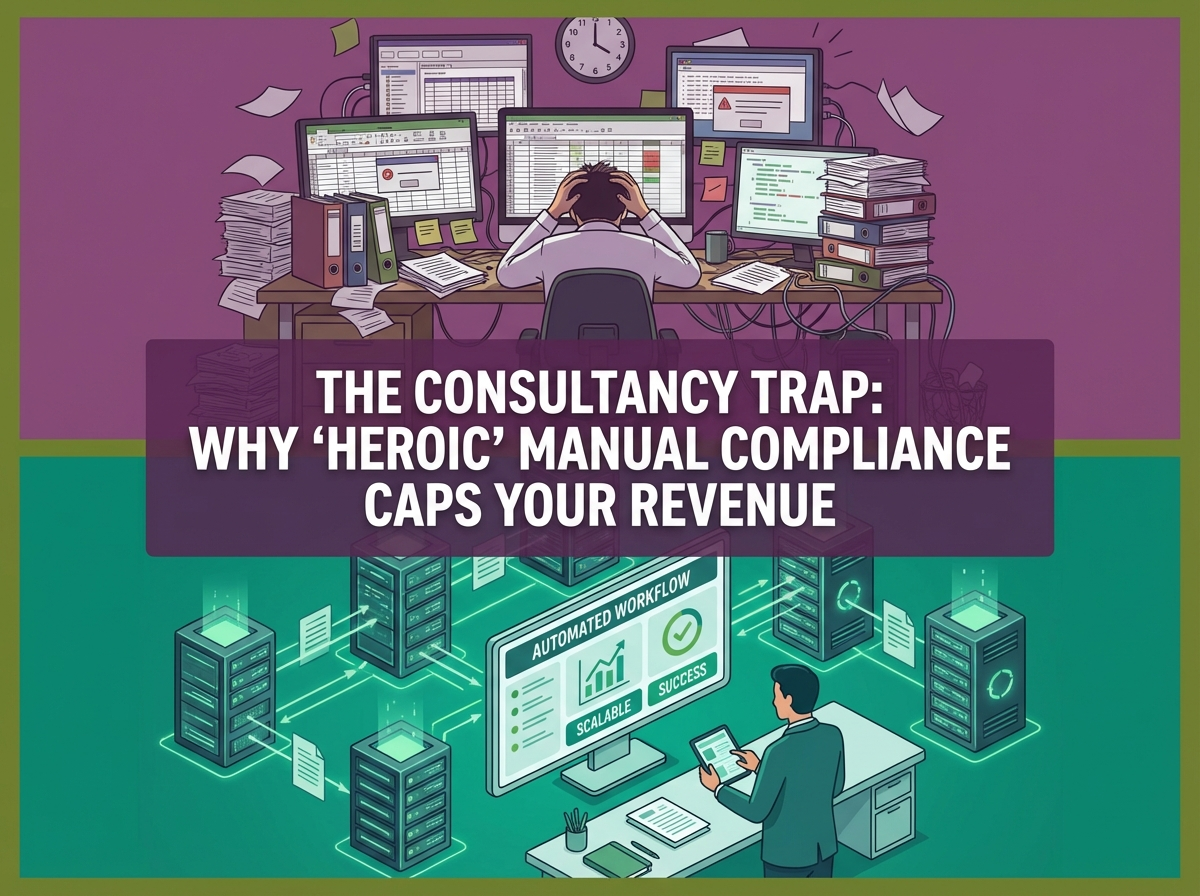
The "Heroic" Ceiling
If you run a boutique consultancy in ESG, EUDR, or regulatory reporting, you know the pattern.
You win a new client. You promise a smooth, low-friction filing experience. Everyone's excited.
Then reality hits.
Your team spends the next month buried in Excel, chasing clients for missing data, untangling email threads, and wrestling with government portals that were clearly not designed for scale. People are working late, double-checking everything by hand, and hoping nothing slips through the cracks.
On paper, the firm looks successful. In practice, it's fragile.
Your delivery depends on "heroic staff": senior consultants who remember every exception, every nuance of the portal, every odd rule from that one regulator. The real operating model lives in their heads, not in a system.
That's sustainable with 5 clients.
It falls apart at 50.
This is what we call The Manual Middle: the stage where work is too complex for off-the-shelf tools, but still handled with spreadsheets, inboxes, and ingenuity. It's also where your margins quietly disappear.
We recently worked with a compliance operation stuck at this "scale wall." Their recurring Due Diligence Statements (DDS) for EUDR were piling up. Their senior experts were reduced to glorified data typists. Burnout risk was high. Error risk was higher.
They didn't have a people problem. They had an operating model problem.
Three Signs Your Consultancy Needs "RegOps"
From working with firms in the 5-30 employee range, the pattern is consistent. When manual processes are capping your growth, it usually shows up in three ways.
1. Your "Recurring" Revenue Is Really Just Recurring Stress
You're selling recurring filing services: monthly, quarterly, annual. On the slide deck, this looks like healthy, predictable revenue.
But inside the firm, every cycle feels like a fire drill.
-
Client data comes in however the client feels like sending it: buried in email bodies, zipped PDFs, half-complete Excel files, screenshots.
-
Your team spends most of its time cleaning, reconciling, and massaging that data into something usable.
-
Actual advisory work becomes the minority of the job.
In many firms, this splits out roughly as:
-
80%: chasing, cleaning, and reformatting data
-
20%: applying expertise and judgment
The problem isn't that the work exists. The problem is that it's invisible, manual, and hard to standardize. We break down how this fragmentation kills scalability here.
If every billing cycle feels like a fresh crisis, you're not running a recurring revenue operation. You're running recurring chaos.
2. You Trust the Person, Not the Process
Ask yourself a simple question:
If your best Senior Analyst woke up sick tomorrow, would you trust your deadlines?
Most partners quietly know the answer.
There's usually one person (maybe two) who:
-
Knows which portal fields are "fake required" vs actually enforced
-
Remembers the odd exception for that one client's entity structure
-
Carries the checklist for "what always goes wrong" in their head
You don't trust the system. You trust that person.
A comment from a user on r/sysadmin about audits captures this nicely:
"Manual tracking has already become a huge time suck... as a one man show — [automation] is absolutely worth it."
For a consultancy, this isn't just a productivity issue. It's a key-man risk. Your "bus factor" is basically one.
You cannot scale a firm where the real process is "Ask Maria, she knows how to do it."
What you need is a RegOps Bridge: a workflow backbone that:
-
Knows what needs to happen for each filing
-
Enforces the right checks in the right sequence
-
Keeps a clean, auditable trail of what was submitted, why, and by whom
So the work gets done correctly even when Maria is on holiday.
We unpack the RegOps Bridge philosophy here.
3. You're Turning Down Work (Or Secretly Dreading It)
This is the most obvious sign.
You get offered:
-
A new 500-filing mandate
-
A multi-country expansion of an existing client
-
A short-deadline remediation project across several entities
On paper, it's exactly the kind of contract you want. In your gut, you hesitate.
You know your current operations team is already stretched. There's no clean way to slot in that extra volume without breaking something:
-
People
-
Deadlines
-
Quality
-
Or all three
So you either say no, or you say yes and quietly hope everyone can "push through" again.
That's not a sales problem. That's an operating model ceiling.
The Case Study: Breaking Through the Ceiling
One of our clients, a French operator, faced this head-on.
They were staring down a massive volume of EUDR submissions. The math simply didn't work. If they tried to handle everything manually:
-
They'd need to hire a small army of people
-
They'd still be error-prone
-
Margins on fixed-fee contracts would evaporate
Hiring more bodies wasn't the answer. The bottleneck was the workflow.
Instead, we worked with them to build a RegOps Bridge: a dedicated automation layer between their internal data and the EU's complex SOAP interface.
Instead of:
-
Exporting data into spreadsheets
-
Reformatting everything by hand
-
Logging into portals and copy-pasting
The Bridge handled:
-
Structured data intake from upstream systems
-
Validation and transformation based on the EUDR rules
-
Automated communication with the EU SOAP interface
The Result:
-
Volume: They scaled to thousands of monthly filings without adding headcount.
-
Margins: Cost-per-filing dropped by roughly 60%, restoring margin on fixed-fee engagements that previously felt underwater.
-
Sanity: Their team shifted from being "data entry drones" back to being "compliance experts" who monitor, interpret, and improve the workflow rather than execute it manually.
The work didn't disappear.
It moved from people's heads and hands into an auditable system.
The Shift: From "Consulting" to "RegOps"
If you want to grow past 30 people without burning out your seniors, you need a mindset shift.
Recurring filings are operations, not just consulting hours.
Your expertise still matters. In fact, it becomes more valuable. But its role changes:
-
From: "Manually guiding each filing across the line"
-
To: "Designing, owning, and improving the workflow that gets filings across the line"
That shift usually looks like this:
-
Intake is structured
No more digging through inboxes and Slack threads for "the latest version."
-
Clients upload data in agreed formats
-
Portals or forms enforce required fields
-
You capture the right metadata the first time
-
-
Processing is automated
Your rules and checks don't live in someone's memory or a tab in a forgotten spreadsheet.
-
Validation rules run automatically
-
Common transformations are encoded once, then reused
-
Exceptions are flagged clearly, instead of buried in a sheet
-
-
Submission is a click, not a grind
Submissions move through a defined pipeline.
-
Portals are integrated wherever technically and commercially viable
-
SOAP or API interfaces are wired into your workflow
-
Manual steps are the exception, not the rule
-
Your consultants are still essential. But now they're working at the right altitude:
-
Designing controls
-
Reviewing edge cases
-
Interpreting regulation
-
Managing risk and client relationships
Not wrestling with CSV formats at midnight.
Where to Go From Here
If any of this sounds uncomfortably familiar, you're not alone. Most boutique ESG and regulatory consultancies hit this ceiling. The firms that break through don't just "work harder." They build a RegOps layer underneath their expertise.
If you want to see what that looks like in practice:
-
See how we wired an EUDR RegOps Bridge into the EU's SOAP interface
-
Read more on how RegOps protects your margins and de-risks scale
Stuck in spreadsheet hell? We help consultancies build auditable workflow bridges so your team can stop living in crisis mode. Let's sketch your workflow.
Ready to automate your workflow?
Schedule a 30-minute call to discuss your automation needs. We'll help you identify your biggest bottleneck and show you what's possible.
Schedule a Call