Building vs. Buying: When Custom Automation Makes Sense
Should you buy off-the-shelf software or build custom automation? Here's a framework to help you decide, plus real examples of when custom solutions save time and money.
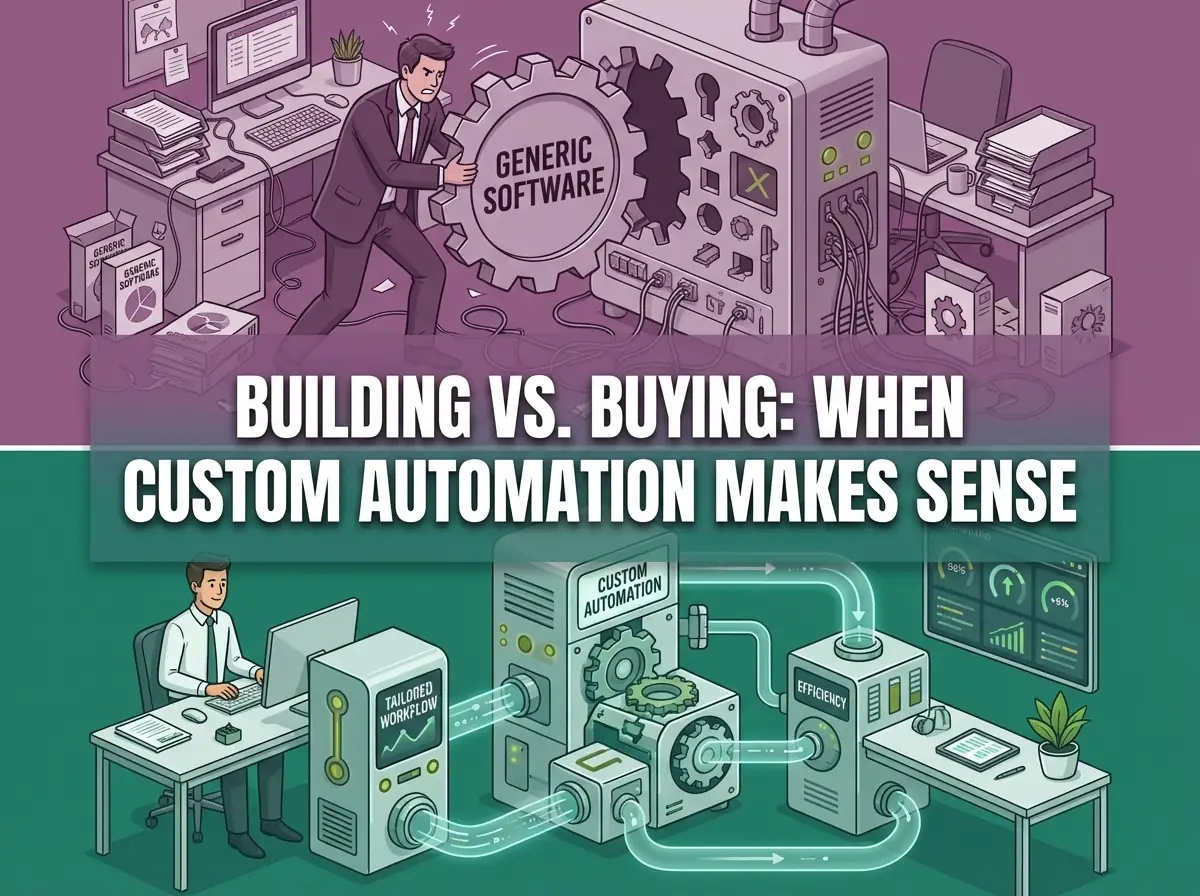
The Trap: Enterprise Software Built for Problems You Don't Have
Most compliance consultancies have lived some version of this story.
A vendor shows you a polished demo and says something like:
“Buy our platform. It handles EUDR, ESG, AML, KYC, everything. One system. End-to-end compliance.”
The numbers seem to work at first glance:
€500–5,000 per month for “enterprise-grade” compliance software. Cheaper than another full-time hire, right?
Then the real work starts:
- Implementation stretches into months.
- The vendor keeps asking you to “standardize your workflow” to fit their platform.
- Your team quietly sticks to email, spreadsheets, and the tools they already know, because the new system doesn’t match how they actually work.
- Eighteen months in, you’re using a tiny slice of the features, adoption is low, and nobody is excited about logging in.
You didn't buy a solution to your problem.
You bought enterprise software designed for someone else's problem.
When Buying Off-the-Shelf Compliance Software Makes Sense
Off-the-shelf tools absolutely have their place. The key is to recognize when your problem is genuinely “standard.”
Buying tends to work well when:
- The problem is common and well-understood.
Payroll runs, basic HR workflows, generic policy attestations, standard reporting. - You’re willing to adapt your process to the tool.
You don’t mind using the vendor’s view of “how this should work.” - You don’t need heavy integration.
It’s fine if the tool runs mostly on its own, with limited data exchange. - The ROI is obvious.
You can clearly see that the hours saved are worth the subscription.
Typical “buy” candidates:
- General accounting and invoicing software
- Basic GDPR consent and cookie tracking
- Standard form builders and survey tools
Typical “don’t buy blindly” areas:
- Specific regulatory submissions (EUDR, sector-specific ESG, niche local rules)
- Multi-client, multi-jurisdiction filing workflows
- Anything tightly tied to your methodology or competitive edge
See why manual EUDR compliance fails at scale here
Once your work involves nuanced, client-specific workflows and complex review chains, generic platforms start feeling like a blunt instrument.
When Building Custom Compliance Automation Is the Better Move
“Build” doesn’t have to mean a giant IT project or replicating an entire platform. Often, it means a focused, custom “RegOps bridge” that connects your existing tools and processes into something coherent and auditable.
Building starts to make sense when:
- Your workflow is genuinely unique.
Your clients, jurisdictions, and review steps don’t match what a generic platform was built for. - You need deep, reliable integration.
Data has to move cleanly from client systems → your internal checks → regulator submissions → client reporting. - Off-the-shelf tools feel bloated.
You’d be paying for 200 features to use 10, and working around the rest. - You can quantify the impact.
You know how many hours per filing you’re burning and what reducing that would mean for margin. - You care a lot about auditability and control.
You want a clear view of the logic, the data, and the change history, not a black box.
Good places to consider custom builds:
- Submission pipelines for specific regulations
- Custom ESG or sustainability reporting engines
- Multi-client filing engines with recurring deadlines
- Bridges between existing back-office tools and client portals
This is where a narrow, well-designed system often beats a broad, generic platform.
Real Case Study: When Payroll Became Strategy At Trusted Health
To ground this in reality, it’s helpful to look at a public, non-fiction example where a company deliberately chose to build a custom system instead of buying an enterprise product.
Trusted Health is a healthcare staffing company that connects nurses with jobs. They faced a decision around payroll and pay experience that maps very closely to the “build vs. buy” question many consultancies face in compliance.
They could have plugged into a standard payroll or HR suite. Instead, they built a custom payroll system.
Why?
- A distinctive pay experience tailored to travel nurses
- Logic that reflected the specific realities of nurse assignments, bonuses, and incentives
- The ability to shape and iterate on that experience without waiting on a vendor roadmap
Quoting the Retool case insight in summary form: they chose to build because they wanted a “unique and unmatched experience” that standard payroll platforms weren’t designed for Retool build vs buy guide.
In other words:
- Payroll, for them, was core to differentiation, not just admin.
- Existing products were too generic for the level of nuance they needed.
- Owning the system gave them speed and control.
For a compliance consultancy, swap “payroll” for:
- How you run due diligence
- How you structure evidence and audit trails
- How you orchestrate multi-client, multi-regulator workloads
If that orchestration is central to how you win and keep clients, you're much closer to Trusted Health's situation than to a generic "we just need a tool" scenario.
The Build vs. Buy Decision Framework
You can make this less emotional and more structured with a few direct questions.
Question 1: Is this problem specific to our consultancy’s workflow?
- Yes → Lean Build
- No → Lean Buy
Question 2: Can we clearly calculate the ROI of solving this?
- Yes, we know hours and costs → Lean Build
- Vague or “nice to have” → Lean Buy
Question 3: Do we need deep integration with multiple systems?
- Yes, data moves across several tools/teams → Lean Build
- No, the tool can sit mostly on its own → Lean Buy
Question 4: Are we willing to change our workflow significantly?
- No, our current process is honed and defensible → Lean Build
- Yes, we’re happy to adopt a standard model → Lean Buy
Question 5: Is this process part of our competitive advantage?
- Yes, it’s central to why clients pick us → Lean Build
- No, it’s more of a support function → Lean Buy
How to read your answers:
-
4+ “Build” answers:
Custom automation is probably the stronger path. -
4+ “Buy” answers:
A well-selected off-the-shelf tool will probably serve you better. -
A mixed result:
You may need a hybrid: a general platform plus custom bridges where your workflow is unique.
The Maintenance Myth: "Custom Code Breaks, SaaS Doesn't"
A common worry:
“If we build our own system, we’re stuck maintaining it. At least with SaaS, someone else is responsible.”
Enterprise SaaS reality:
- Vendors ship updates on their schedule.
- Regulatory changes often trigger reconfiguration projects inside the platform.
- You inherit their design assumptions and roadmap, including things you don’t need.
- You may be locked into a way of working that is painful to unwind later.
Custom RegOps bridge reality:
- You control the release schedule and the change scope.
- Updates can be small, targeted, and tested in your environment.
- You’re not beholden to a vendor’s priorities when regulations shift.
- You can design the system around your audit and evidence needs from day one.
Done well, a focused custom system can be more predictable than living inside a very large, ever-changing platform.
Cost Comparison: A 3-Year View
Let’s compare rough, realistic costs over three years for a “serious” compliance platform versus a custom bridge. Numbers will vary, but the pattern is what matters.
Enterprise Compliance Platform:
-
Year 1
- €60k software license
- ~€30k implementation, configuration, and training
- Total: ~€90k
-
Year 2
- €60k license
- Additional consulting if your needs evolve
- Total: ~€60k+
-
Year 3
- €60k license
- Potential extra spend for new modules or added users
- Total: ~€60k+
Three-year total: ~€210k, often higher once you factor:
- Time spent bending workflows to fit the platform
- Lost hours from low adoption
- Rework when regulations or your services change
Custom RegOps Bridge:
- One-time build: ~€15k for a focused, well-scoped system
- Maintenance/retainer: €3k/month × 36 = €108k across three years
- Hosting and infrastructure: roughly €50–100/month ≈ €2.4k over three years
Three-year total: ~€125k
So you’re looking at €80k+ in direct savings, plus:
- A system tailored to your actual process
- Faster changes when rules or clients change
- Less internal friction and better adoption
The exact numbers will differ for your firm, but the pattern shows why custom can be both cheaper and better when the workflow is specific and repeatable.
Warning Signs Your "Buy" Decision Isn't Working
If you already have a compliance platform in place, some common red flags signal that you might have overbought:
-
“We bought it, but the team barely uses it.”
The tool doesn’t fit day-to-day reality. -
“Implementation took more than 6 months.”
The solution is likely more complex than the problem you actually needed to solve. -
“We’re paying for features and modules nobody touches.”
You’ve bought into enterprise bloat. -
“Every time rules change, we’re scrambling to reconfigure.”
The platform isn’t flexible enough around your real regulatory environment.
If several of these sound familiar, it's a good time to step back and reassess where a smaller, custom bridge might serve you better.
When To Revisit Your Build vs. Buy Decision
Even if buying made sense when you started, growth can change the equation.
It’s worth revisiting your setup if:
-
Your firm has grown to 10+ people.
Processes are now repeatable enough to justify automation tailored to you. -
You’re handling 100+ recurring filings per quarter.
Small inefficiencies compound into serious cost and burnout. -
Your margins are tightening.
You’re spending heavily on software, manual work, or both. -
You’re turning down work.
Your operations can’t scale without either more headcount or better systems.
If you want to step back and look at the bigger picture of RegOps for consultancies, have a look at:
The strategic case for RegOps in consulting firms
See the technical architecture of a RegOps Bridge to understand how these systems are built.
Next Steps
If you’re in the middle of a build-vs-buy decision for compliance automation, a simple way forward is:
-
Run the framework with your partners.
Answer the five questions honestly, not to defend a decision you’ve already taken. -
Quantify your current process.
How many hours per filing, per quarter, per consultant? What does that cost you? -
Assess your technical options.
Do you have internal capacity, or do you need a partner who understands both regulation and software? -
Talk to teams who built and teams who bought.
Learn from real experiences, including ones like Trusted Health’s, where a critical workflow moved from “back office” to “strategic asset.”
If you want to explore whether a custom RegOps bridge makes sense for your consultancy and where it should sit alongside any existing tools:
Let's discuss the right approach for you.
Ready to automate your workflow?
Schedule a 30-minute call to discuss your automation needs. We'll help you identify your biggest bottleneck and show you what's possible.
Schedule a Call